As a young pharmacist, I remember the popularity of codeine containing products--Tylenol® With Codeine, Empirin® with Codeine, and many formulations of cough syrups with codeine. But as the years have gone by, the rationale for using these products has fallen by the wayside.
First of all, codeine in and of itself is a prodrug. It does not have any pharmacological effect until it is converted by bodily enzymes into morphine, its active form. Due to genetic variability some people do not possess the enzyme that is responsible for this conversion. When these persons are ordered codeine containing products for pain, or for cough, it does not provide analgesia or cough suppression. Conversely, there are also "ultra-rapid metabolizers" of codeine--in this group, codeine is very quickly converted to morphine, so quickly in fact, that the effect can result in toxicity. Since the medical field does not genetically test people routinely to see who can or can't metabolize codeine, other available alternatives have been deemed more favorable.
In recent months, the American Academy of Pediatrics is recommending against the usage of codeine in children. One reason cited for this is that fatal breathing reactions have occurred in children using this drug. The US Food and Drug Administration added a "Black Box Warning" to codeine containing products. The problems are especially of concern in children who underwent tonsillectomy and adenoidectomy due to increased risk of respiratory failure in this group.
Here is the black box warning as issued by the FDA:
Sources: Medscape.com; wikidoc.org
First of all, codeine in and of itself is a prodrug. It does not have any pharmacological effect until it is converted by bodily enzymes into morphine, its active form. Due to genetic variability some people do not possess the enzyme that is responsible for this conversion. When these persons are ordered codeine containing products for pain, or for cough, it does not provide analgesia or cough suppression. Conversely, there are also "ultra-rapid metabolizers" of codeine--in this group, codeine is very quickly converted to morphine, so quickly in fact, that the effect can result in toxicity. Since the medical field does not genetically test people routinely to see who can or can't metabolize codeine, other available alternatives have been deemed more favorable.
In recent months, the American Academy of Pediatrics is recommending against the usage of codeine in children. One reason cited for this is that fatal breathing reactions have occurred in children using this drug. The US Food and Drug Administration added a "Black Box Warning" to codeine containing products. The problems are especially of concern in children who underwent tonsillectomy and adenoidectomy due to increased risk of respiratory failure in this group.
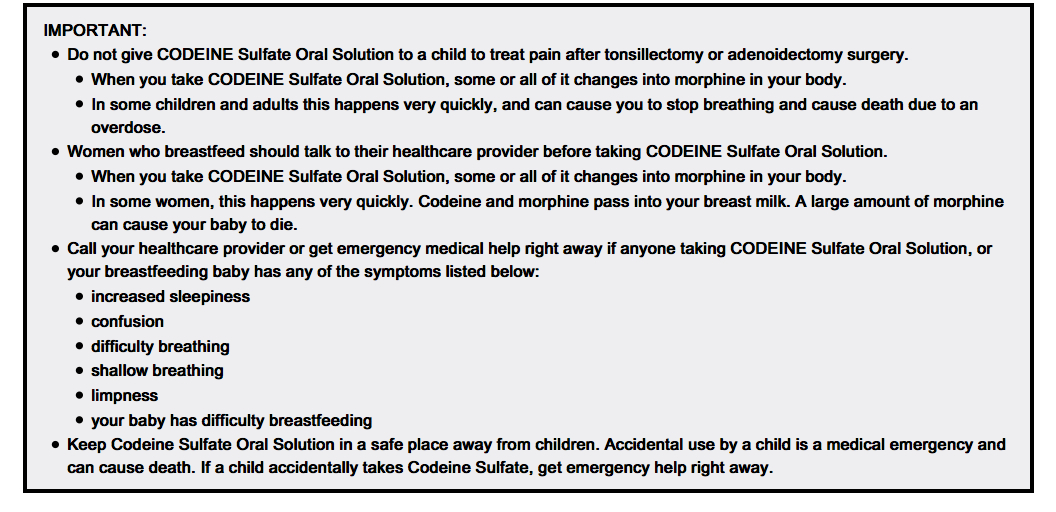
Here is the black box warning as issued by the FDA:
 |
| (Click image for larger photo) |
Comments
Post a Comment